
Double-covered yarn
Have you ever seen the phrase “double-covered yarn” in the description of a pair of stockings or tights and wondered what it means?
It is a technical feature often associated with quality products, yet it is not always clear what sets it apart from other yarn constructions.
In fact, the way a yarn is constructed can significantly affect the fabric’s properties: from stretch and how it feels against the skin to the evenness of its appearance.
Let’s look at what double-covered yarn is, how it is made and what benefits it can offer in stockings and tights.
We also covered this topic in one of our Instagram reels.
If you prefer a quick explanation, you can watch the video below!
What Is Covered Yarn?
To understand what double-covered yarn means, we need to start with a key concept: yarn structure.
The production of stockings and tights often uses elastic yarns made from different materials, each with a specific role. One example is covered yarn: an elastic central core, usually elastane, is wrapped with another filament, often polyamide. The two materials serve different purposes:- Elastane gives the yarn its stretch, allowing it to extend and return to its original shape.
- Polyamide forms the outer covering, contributing to the look, feel and protection of the elastic core.
What Is the Difference Between Single- and Double-Covered Yarn?
The key difference lies in the number of filaments used to cover the elastic core.
Single-covered yarn
In single-covered yarn, one filament is spirally wound around the elastic core.
This construction can produce elastic yarns with different characteristics, depending on the materials used and the manufacturing parameters. Single-covered yarn is also used to make stockings and tights, particularly where specific levels of lightness, stretch or fabric appearance are required.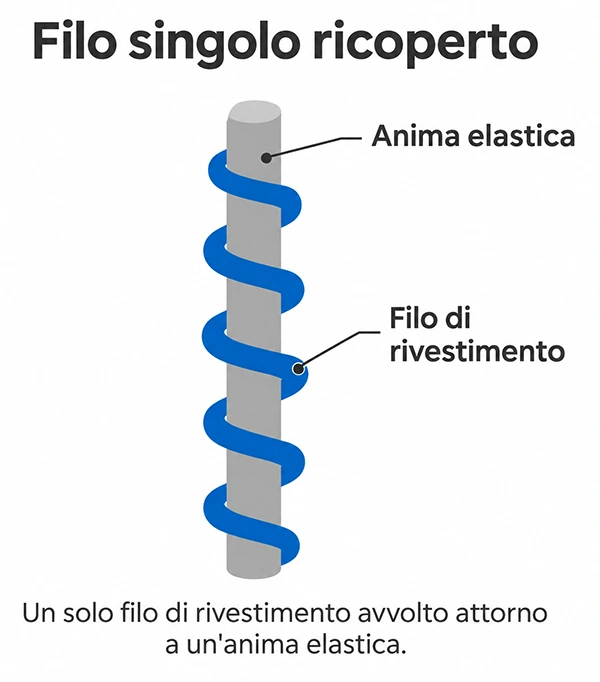
Double-covered yarn
In double-covered yarn, by contrast, the elastic core is wrapped with two covering filaments.
In the traditional construction, they are wound in opposite directions: one clockwise and the other anticlockwise. This arrangement helps balance the yarn’s twists, making its structure more stable. Double covering also provides greater protection for the elastic core and can achieve specific aesthetic and mechanical properties.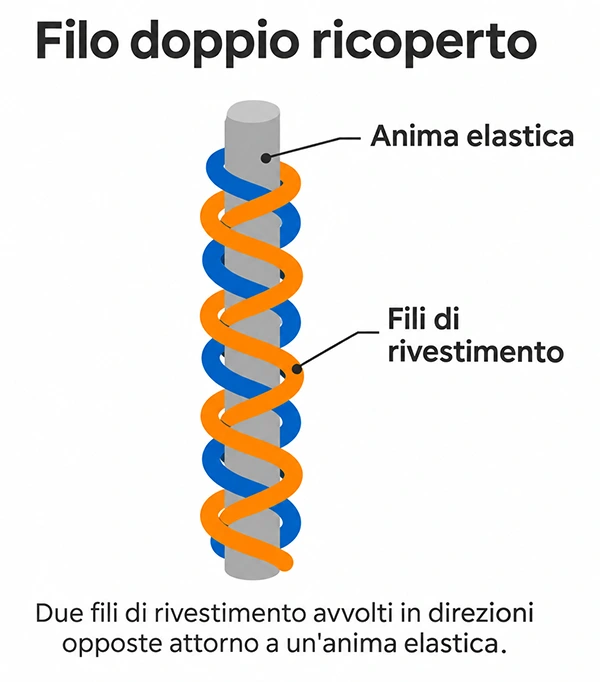
Please note: double-covered does not simply mean using a yarn that is twice as thick. It is a different yarn-construction technique.
What Are the Benefits of Double-Covered Yarn?
Double covering is used to produce yarns with particular properties. Here are the main benefits this construction can offer.
Greater Yarn Stability
One of the most interesting aspects is the balancing of twist.
Winding the two filaments in opposite directions can reduce the yarn’s tendency to twist on itself. This helps make the construction more even and the yarn more stable.Stretch and Shape Recovery
Double-covered yarn retains an elastic core that allows the fabric to stretch and adapt to the body’s shape.
The structure of the covering can help achieve more controlled stretch and good shape recovery. The final result always depends on the elastane, the filaments used and the fabric construction.Protection for the Elastic Core
The two outer filaments cover the central core and can help protect it from abrasion and mechanical stress.
This may support yarn durability, but it does not mean that every pair of stockings or tights made with double-covered yarn is automatically more durable.Uniformity and Feel
Double covering can help create a more even yarn and a uniform fabric appearance.
The feel against the skin can also vary depending on the type of covering used. For example, particularly fine filaments can help create soft, comfortable fabrics, while other combinations may be designed for a smoother surface or different characteristics.Double-Covered Yarn and Denier: Are They the Same Thing?
No. They are two different pieces of information, even though both relate to the yarn.
As we explain in our guide to denier in stockings and tights, denier indicates a yarn’s linear density: its weight in relation to its length.
The term double-covered yarn, on the other hand, describes how the yarn is constructed.
In other words, denier tells us about a yarn’s fineness, while covering describes one of its structural characteristics.
Both aspects can affect the fabric’s properties, but they should not be confused.
Read the article “What Is Denier in Stockings and Tights?”.
How Can You Recognise Stockings and Tights Made with Double-Covered Yarn?
It is not always possible to identify this construction simply by looking at or touching the fabric.
Products with different constructions can also look very similar.
To find out whether a style uses double-covered yarn, the most reliable source is the manufacturer’s technical documentation or a product page that explicitly states this feature.
The percentage composition alone—for example, 85% polyamide and 15% elastane—does not tell you whether a yarn is single- or double-covered.
That is why at MyLegs we aim to describe product features clearly, helping you understand not only how they look, but also how they are made.
Discover MyLegs Stockings and Tights Made with Double-Covered Yarn
At MyLegs, you can find a selection of stockings and tights made with double-covered yarn, a construction chosen by manufacturers to achieve specific levels of stretch, evenness and comfort.
Our product pages also highlight these technical details, because we know how important they can be when choosing a style.
Through descriptions, photographs and close-up videos, you can learn more about the features of different products and find those best suited to your preferences.
Discover the double-covered yarn styles available at MyLegs.
In Conclusion
Double-covered yarn is a particular textile construction in which two filaments are wrapped around an elastic core, generally in opposite directions.
This construction offers valuable benefits in terms of yarn stability, protection for the elastic core and fabric evenness, contributing to properties sought in the production of stockings and tights.
Understanding yarn structure means better understanding what we wear, looking beyond colour, denier or the product’s appearance.
And that is precisely the purpose of MyLegs Guides & Advice: to help you discover the world of stockings and tights, one detail at a time.
